Postnatal depression
Kim Ji-young, Born 1982Postnatal depression becomes the psychiatrist’s first explanation for Kim Jiyoung’s distress, but not his final understanding of it. As her treatment continues, her symptoms point beyond a single diagnosis: childcare, housework, and the uncounted labor sustaining family life shape the conditions in which her depression develops and persists.
Diagnosis and Treatment
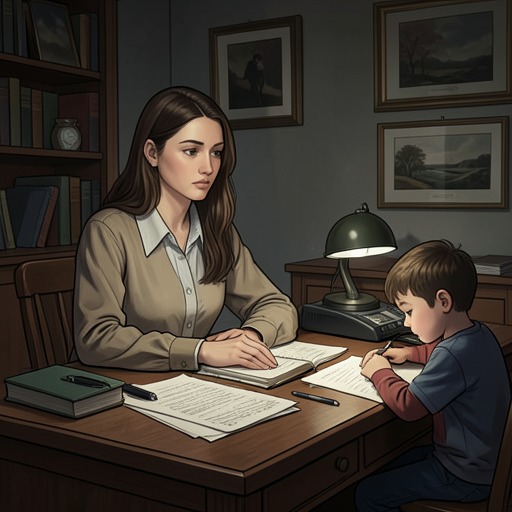
Jung Daehyun first visits the psychiatrist alone to discuss his wife’s symptoms and possible treatment. He has booked an appointment for her because she has not been sleeping well and seems stressed. Kim Jiyoung does not appear fully aware of the condition her husband is concerned about; she thanks him and describes feeling blue and enervated, suspecting that she has maternity blues.
The psychiatrist initially considers dissociative disorder after hearing Jung Daehyun’s account, but his first session with Kim Jiyoung leads him to diagnose a typical case of postnatal depression that has progressed into childcare depression. His later account describes 45-minute sessions twice a week. Her symptoms become less frequent but do not disappear, and he prescribes antidepressants and sleeping pills to alleviate her depression and insomnia. After reviewing her records, he also chooses medication considered safe while she is breastfeeding.
The Burden Behind the Symptoms
At one appointment, the psychiatrist advises Kim Jiyoung to rest her wrists. She explains that she cannot, because she has to care for the baby, do the laundry, and clean. He responds by comparing her circumstances unfavorably with women’s physical labor in the past, reasoning that modern appliances make her complaints unwarranted. The episode shows a gap between the physical effort a machine can reduce and the work that remains: laundry still has to be sorted, washed, hung out, and brought in, while cleaning tools do not complete the housework on their own.
The narrative makes that hidden labor measurable without suggesting that the figures capture its whole weight. After Jung Jiwon starts daycare shortly after turning one, Kim Jiyoung has about three hours to herself between drop-off and pickup. Most of that time goes to laundry, dishes, tidying, and preparing food and snacks; she hardly has time to sit down with coffee. Statistics cited in the account put a stay-at-home mother of a child under two at four hours and ten minutes of personal time a day, compared with four hours and twenty-five minutes for a mother whose baby attends daycare. The fifteen-minute difference underscores that daycare changes where much of the housework is done, not whether it must be done.
Work, Care, and Cumulative Strain
The account also sets Kim Jiyoung’s condition against pressures beyond the home, without reducing her illness to any single cause. At her marketing agency, she likes her colleagues and finds that the work itself is manageable, but clients and reporters are another matter. Older male clients repeatedly direct sexist jokes at her; a client executive labels her a doenjangnyeo after she orders soybean-paste sauce with rice, leaving her to negotiate whether to laugh or silently redirect the conversation.
At a later business dinner, the client company’s male managers steer Kim Jiyoung into the seat beside their division head despite her repeated insistence that she wants to sit with her colleagues. The head makes remarks about her appearance and sex life and pressures her to drink. Such encounters illuminate the gendered expectations she faces at work, including the demand to smooth over insults, but the narrative does not present them as a complete explanation for her depression. At the same time, the job has consumed the mental space she once gave her boyfriend: he waits for her calls and plans, while she feels guilty that she cannot support him as he supported her. Their accumulated disappointment contributes to a major fight after they had already begun drifting apart.
Diagnostic Reassessment
As treatment proceeds, the psychiatrist’s certainty in his initial diagnosis fades. He does not find Kim Jiyoung guarded or antagonistic, nor does she repeatedly return to childhood trauma. She is reserved until encouraged to speak; then she recalls long-buried memories and describes them calmly and articulately. Looking back at the life scenes she chooses to bring into sessions, he recognizes that he may have diagnosed her too hastily. The reassessment does not establish a replacement diagnosis or claim that treatment has ended her symptoms. Instead, it changes what the clinician believes he knows about the world in which those symptoms occur.
That shift has a personal dimension. The psychiatrist reflects that following his wife’s successive compromises in her medical career—from pursuing a university position in ophthalmology to contract work and then giving up the career altogether—had taught him something he had not understood about women’s lives, especially motherhood in Korea. His account therefore places the limits of his earlier awareness beside his reassessment of Kim Jiyoung: clinical care can address depression and insomnia, yet diagnosis alone risks treating distress as an individual problem while overlooking the labor and gendered circumstances surrounding it.
An Uncounted Workload
The narrative refuses both the dismissal of housework as idleness and its sentimental elevation as work that sustains life when neither framing makes its value countable. The psychiatrist’s own assumption that appliances have made domestic labor easy is exposed by the actual sequence of tasks Kim Jiyoung performs, while the daycare statistics show how little additional free time childcare arrangements provide. Against that background, postnatal depression progressing into childcare depression names more than a change in symptoms: it marks the continuing pressure of care work that remains largely private, unequally borne, and difficult to recognize from outside.